Tuesday, 29 September 2009

Just finished two very differnt fantasy novels.


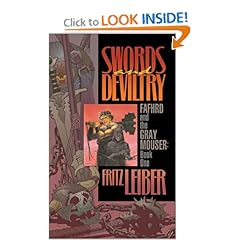
I just finished reading Fritz Lieber's Swords against Deviltry and Parsival or a Knight's Tale by Richard Monaco. Two very different novels - actually Deviltry is three novellas - and two very different approaches to fantasy.

I've always been a Lieber fan. He approaches his subject with a sence of humour and a slight irreverence. The protagonists Fafhrd and the Grey Mouser are probably tow of the most interesting and likable characters in the sword and sorcery genre.


This was teh first novel by Monaco I had read and it did little for me. He had some interesting takes on the Arthurian legends but the overall style and delivery left me cold. The novel seemed to wallow in the sheer awfulness of everything. I don't mind grim and gritty, I enjoyed Joe Abercrombie but you need a certain levity or it becomes a depressing trudge

Friday, 18 September 2009

Quicksilver


I finally finished Quicksilver. I originally bought the novel about five years ago and initially read 200 pages. Stephenson style initially seemed impenetrable with it reams of description and asides. I started it again in May 2008 and maybe read another 100 pages. I found it full of fascinating ideas and historical vignettes but the story was poorly paced and some of the language was strangely anachronistic. In hindsight I realize the author was deliberate in his choice of modern phrases.

I finally picked it up again mainly due to pressure from my better half to empty out some of the book shelves. It took me a few more chapters of slogging but now the book started to hold my attention.

Previously I had enjoyed Stephenson excellent cyberpunk novel Snowcrash. Quicksilver is a very different affair and lacks the former's snappy pace. It's only real science fiction trappings are a fascination with encryption and a minor if significant character Enoch root a possibly immortal alchemist.

The novels spans the middle to late 17th century and takes place in England, France, the German principalities and the Massachusetts colony. It cover a period of religious discord and scientific awakening; the development of the absolute monarchy in France and it's end in Britain.

The main character are Daniel Waterhouse; a contemporary and sometimes friend of Isaac Newton; Jack Shaftoe; rogue, vagabond and adventurer; and Eliza a former slave of the Turkish Sultan's Harem. These characters lives intersect at various point and also interact with a variety of persons of historical significance.

Stephenson style echos that of the early novel not only in the use of language but also in form. Parts of he book are epistolary while other read like a picaresque adventure. Throughout the author provides huge amounts of historical details, some times in overwhelming volumes.

The initial chapters deal with Waterhouse's background and a secondary plot set years later when he is an old man. It was here I kept getting bogged down and it was only in the final pages of the first part of the novel that my interest was really piqued. It also probably took me that long to adjust to Stephenson's style. The introduction of Jack and Eliza in part two brings about a change of pace and scenery and gradually the various plot threads and characters tie into a cohesive whole.

Stephenson is obviously proud of the research he has done and is quite happy to describe in depth everything from pike and shot warfare to the birth of the stock market. While I found each individual subject interesting; some so much so I intend to do further reading on them; they give the story a very stop start, almost episodic feel.

The novels ending ties up enough loose threads to leave me happy but leaves enough plot hooks for the two sequels. i'll certainly read them at some future point but probably when I have more free shelf space.
Monday, 10 August 2009

The Pastel City by M John Harrison


Thanks to Bookmooch I'm able to reread some pulp fantasy novels that I enjoyed in my teens.. The Pastel City was always a favourite of mine. I loaned my original copy to a friend and that was the last I ever saw of it.

It's a compact novel with a simple linear story. The main character suffers from a mild case of the Elric mopes. It is firmly in the dying earth tradition and bears similarities to some of Moorcock's works. Indeed Moorcock is a significant fan of M John Harrison's work. It is Harrison's descriptive prose and sense of the fantastic that really lifts this novel above similar sword and sorcery offerings. The landscape of endless rust deserts and encroaching moors is truly alien. I have read none of his later works and I believe The Pastel City is supposedly the most accessible and most easily defined as genre fiction.

Monday, 27 July 2009

Foucault's Pendulum by Umberto Eco


Finally reading Foucault's Pendulum by Umberto Eco. I started it twice before and both times lost my copy of the book. A conspiracy perhaps?

I love these quotes from Eco from a NYT interview.

All links WFS.

I am wondering if you read Dan Brown’s “Da Vinci Code,” which some critics see as the pop version of your “Name of the Rose.” I was obliged to read it because everybody was asking me about it.

My answer is that Dan Brown is one of the characters in my novel, “Foucault’s Pendulum,” which is about people who start believing in occult stuff.

But you yourself seem interested in the kabbalah, alchemy and other occult practices explored in the novel. No, in “Foucault’s Pendulum”

I wrote the grotesque representation of these kind of people. So Dan Brown is one of my creatures.

Tuesday, 21 July 2009

Interview with Jack Vance

in the NY Times. The Lyonesse books; the first two of which I recently reread; are among my favourite fantasy novels. I've never read the Dying Earth series. I knew it as a source of inspiration for Moorcock's Dancers At The End Of Time and Wolfe's The Book Of The New Sun.

The interview is a fantastic insight into Vance's life and works. I will be buying or mooching more of Vance's work presently.